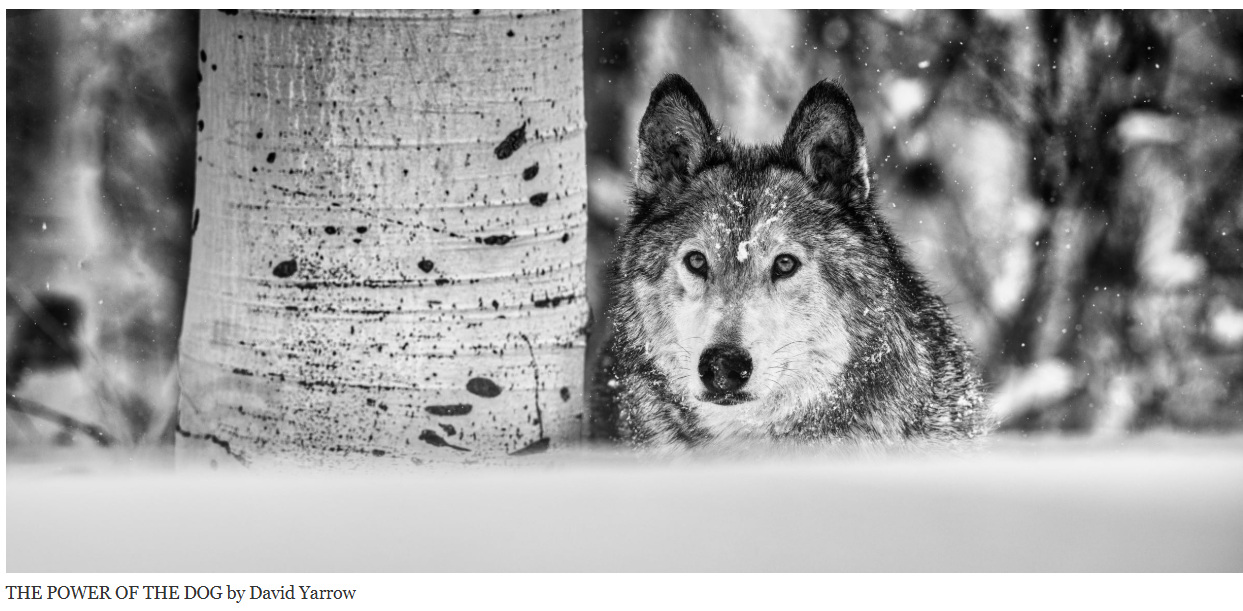
The preceding chapter to this one describes my first visit to the Alladale Estate in the Scottish Highlands, home of my friend Paul Lister, the godfather of rewilding, who has worked for years to reintroduce wolves to his estate and those neighbouring it. There I also met his fellow guest, Dr Doug Smith, the US National Park Service biologist who helped reintroduce wolves to Yellowstone National Park and subsequently led its celebrated wolf project. The chapter after this one will recount my visit to Chernobyl, where wolves stepped in where humans fear to tread…
“The wolf is the arch type of ravin, the beast of waste and desolation.”
— The 26th United States President Theodore Roosevelt, Hunting the Grisly and Other Sketches
In the winter of 2013, I sat in the dark outside the dining room of the house in which I had been born, at Layer-de-la-Haye, in the oldest part of Roman Britain – those martial adopted sons, Romulus and Remus, of Lupa, the great she-wolf who suckled them – with one of my father’s nineteenth-century John Manton twelve bores on my lap.
I had loaded for wolf, but given the ammunition stores available in our rural East Anglian home, which are tuned towards 3lb game birds not 70lb predators, the best I had were No. 5 loads: a couple of hundred 1/8th of an inch lead pellets weighing about an ounce propelled by 25 grains of smokeless powder. The sort of shot where you need to wait until you see the colour of their eyes, not just the whites.
I had only gone outside to smoke a cigarette, but as I did so a message had arrived from one of my relatives, another sort of wolf, who owned a notable nightclub in Chelsea.
“Did you see the news? The wolves have escaped from the zoo near your house.”
And then.
“Have fun cousin. Love, Rollo”
I switched on the news and discovered that five of the six timber wolves at Colchester Zoo, two miles from my family’s house, had broken out of their enclosure that morning.
One returned of his own accord. Another was harmlessly tranquilised with an anaesthetic dart within the zoo grounds and recaptured.
However, three were not so lucky.
The moment the animals were out of the grounds of the zoo, the converted old manor house of Stanway Hall, the police were alerted.
One imagines for them it was rather fun: Colchester is a garrison town, so their main source of excitement that I have witnessed is breaking up fights between drunken soldiers and locals who resent a uniform that spells competence and valour. This day, the police got to make like the military and check their Sig Sauer semi-autos and Heckler & Koch carbines out of the armoury.
Meanwhile the vets with their tranquiliser guns made the heart-breaking decision to stand down, and the keepers assigned, licensed and trained as firearms operators were doing something very different from their police counterparts.
These same zoo staff had celebrated in the media when these very wolves were born to their father Wilfy and mother Tallulah in 2006, the first cubs born at the zoo in twenty years. Now, the people paid to care for them were loading Mossberg pump-action shotguns with single slugs of lead powerful enough to stop a charging bear.
The official explanation – and the true one – was brutally simple. A tranquilliser dart does not drop an animal as a bullet does. The anaesthetic can take fifteen minutes to work and, in a highly stressed wolf, might fail altogether, leave it confused and aggressive, or kill it slowly and unpleasantly given the doses required to counteract the adrenaline coursing through their blood.
While an animal remained within the zoo perimeter there was time and containment enough to attempt it; once it had crossed that boundary and entered open country, the calculation changed. The wolves had become Category 1 dangerous wild animals loose among roads, houses and fields, and lethal force became the prescribed response.
They found the first two in the fields and woods I know so well nearby, and despatched them quickly, single shots by all accounts.
It is the last one I think of though. The search lasted through the day, they even brought in a helicopter with thermal imaging.
In the end they found it – they never said the name or the sex, whether it was Tip Toes, Two Socks, Kenai or Montana – cowering in deep cover off the main road to Maldon. Seven shots were heard, the entire magazine of a Mossberg 500. That’s literally half a pound of lead delivered at over 1,000 mph into a terrified and beautiful animal.
Why?
It was an obscene little chain of causation. Someone believed that cutting a fence would set the wolves free. Wolves that had never been in the wild in a land where wolves had not been truly wild for perhaps a millennium.
All it did was condemn three of them to death and bereave the remainder of the pack so some thoughtless self-important human could feel good about themselves: a sort of woke-icide, a performative slaughter of the innocent.
The public account never established how the escape happened. The zoo professed itself unable to understand how the wolves had broken through a purpose-built stainless-steel perimeter fence.
That is not what I was told in private by those who worked there that day. They were certain the enclosure had been deliberately cut and forced open. And they did not tell this to me tentatively.
Once again, I am confronted with the murderous arrogance of those who believe in their cause too strongly – whether it be for saving the wolf or saving others from the wolf, it only leads to one thing: erroneous death.
Whoever believed they were liberating wolves had misunderstood the fundamental relationship between wolves and men. A wolf outside a zoo in Essex is not returned to nature. It has merely crossed an invisible line in a landscape which belongs almost entirely to Man, and on the other side of that line we have helicopters, guns and rules governing what happens when a large predator appears where we no longer permit large predators to be.
Which is why by nightfall three wolves were in body bags.
And from the house in which I was born, only a few miles away, I heard the survivors howl.
There are sounds which England has forgotten.
This was one of them.
It came through the winter darkness across the fields exactly as that sound must once have travelled across this country before we exterminated the animal that made it.
So I sat outside with a cigarette, listening, with an old English gun across my knees and wondered when the last time that howl had been heard here.
* * *
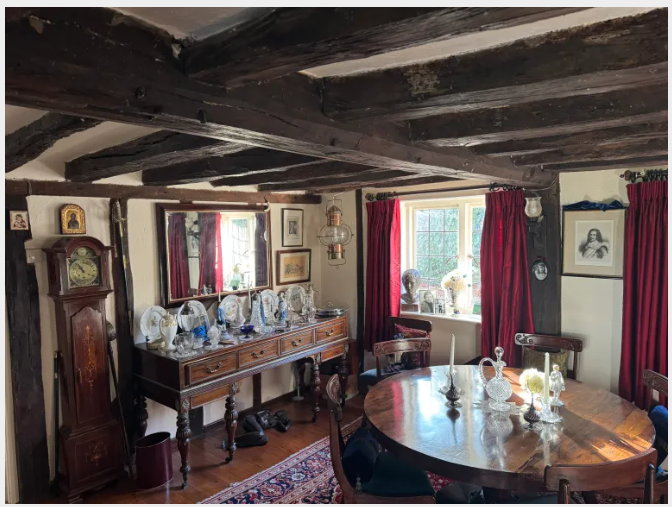
I was born in this house, and of all its rooms I have always loved the dining room most because it is the oldest part of it.
Fishers was extended and divided under Elizabeth I, gentrified under George VI, unified, modernised and expanded under the young Elizabeth II. However, in that one room the pure original structure shows through. The great oak beams are not elegant. They are worked with skill rather than refinement: heavy timbers joined closely while still green, irregular where the tree itself was irregular, knots and bends left where there was no reason to waste good wood merely to make it prettier. Axe and adze, mortise and mallet: the carpenters knew exactly what they were doing and what they were not doing was building for a gentleman, but neither were they erecting a hovel.
There is too much timber, too much labour, too much competence in the framing for poverty. There was an upper floor from the beginning, supported by oak substantial enough to survive every alteration made around it. This was the house of a free man who possessed something, though not very much: land, animals, tools, a little money; enough independence to commission good work but not enough nor enough vanity to require ornament.
And the timber is old. Very old.
One can read the carpentry, the construction and the history of the landscape around it. They point backwards towards the later Middle Ages, back to the middle of the fourteenth century.
Which is an unfortunate date to find in an English house, for in 1349 England was dying.
Let us therefore do what we did in Chauvet and reconstruct a life in accordance with the evidence, not against it.
* * *
Let us call him Hugh, because it was the name of my own ancestor who was living not 40 miles away at Laxfield at that time. But let us call him Fletcher rather than Fiske, as that was a common trade during the Hundred Years war and could have been his father’s occupation.
Let’s imagine Hugh Fletcher in his late thirties, as I was when I heard the wolves howl. Although there the resemblance ends: I have my adult life moving between countries and continents; Hugh spent nearly all of his within a day’s walk of this patch of North Essex.
Except, perhaps for one extraordinary interruption, which explains why he owns — or, more properly termed for the period, holds — this small sturdy house and the land around it. Ten acres are enclosed. Beyond them lies the open waste of Layer Heath where, by right and custom, his animals may graze.
There are perhaps a dozen other inhabited houses spread across hundreds of acres. This is not a village as we would understand one now. No high street, no row of cottages, no pub, no shop, no green ringed by houses. There are isolated holdings, farms, the Norman church standing on its hill with a view to the coast to spot raiding parties, Blind Knights Manor across the heath, Rye Manor Farm on the other side of it, tracks through field and forest connecting one tiny island of human occupation to another.
Hugh is no peasant. He is not starving in mud. He is a free man and a landholder. There is no coat of arms over the door, only solid oak timber beams, no servants in the great hall, only perhaps some sons and daughters to help with the animals, and the hall is not by any means great at 22 feet by 12.
He has no knight’s destrier – heavy charger – in the stable, only a sturdy mare, a ‘stot’ as they were called here, for the saddle or the cart. It shares the stable with a couple of cattle for milk and a young one for meat, maybe twice that number of pigs, maybe twice that again for sheep, and then the chickens and the geese and they all freely roam the hundreds of acres of Layer Heath’s common pasture and forest by day and are gathered and cooped or fenced from foxes or felons by night.
The geese are important not just for meat as are the poplar trees (that stand here to this day) not just for firewood. Hugh’s name is Fletcher because his father’s was, and his father before: a man who put goose feathers on rounded poplar hafts and made the English Army undefeatable for generations. He grew up with his father’s yew bow, that old British tree that overhangs so many graveyards because it takes a millennium to die, more than twice as long as the oak from which our navy was built.
He was engaged in archery practice from such a young age that his wife and children remarked on how he walked as though his two arms belonged to two different men, one strong, one supple.
The great wars of the fourteenth century were not fought and won by knights. In fact, fewer than 500 English knights boarded our oak-hulled ships when Edward III made his claim to the French throne. Among the 15,000 professional soldiers in total who embarked that day, of whom 5,000 were bowmen, were 200 archers from Essex.
On first landing, at Caen, Hugh saw a city stormed and sacked. At Crécy he stood among the English archers as they mowed down the flower of French chivalry. Then, after the siege of Calais, he returned with the plunder that was a soldier’s right and somewhere around £10 in accumulated salary.
Just as importantly, he returned having seen what organised violence does when organisation fails.
He saw dysentery move through camps. He saw wounded men rot. He saw horses die and carcasses swell. He watched sickness cluster among filth, bad water, crowded quarters and bedding passed from man to man.
Hugh had made no study of virology, bacteriology, or epidemiology. He hadn’t even studied the then contemporary miasma theory – the idea of corrupted or pestilential air and vapours.
And he did not need to have done so: human beings could discern patterns of danger long before they learned microbiology.
And so he, when he returned, paid the Lord of the Manor, took his wife and children, and moved to a cleared space in the middle of the woods, bought enough animals and planted enough crops to last – with a fresh water well which stands to this day – put his war bow on the wall with his bodkin arrow-head sheath, his sword– and took up his old hunting bow and shepherd’s crook, whistled for his two mastiffs, stroked the cat that kept the rats out of the grain, and enjoyed his new found life and peace.
* * *
Three years later, word began coming from Colchester that a great pestilence had come to England, arriving in London. People were dying.
Then, a week later, word from Colchester ceased. Then the other villages of the Hundred of Lexden fell silent: Copford, Beresford and Wivenhoe, then Layer Marney, Layer Breton and Birch.
Disease does not move as armies move: no banners are visible above the trees, no column approaching along the road. You cannot see the Viking longships beaching on the coast five miles from the hill upon which the village church was built, Layer deriving from the Anglo-Saxon legra, meaning look out.
Instead, there are absences – the travellers and tinkers, the friars and pedlars – and then… silence. The roads dry up like a stream in a summer that has lasted too long.
* * *
Let us imagine further: after they had not heard from another soul for several days, a lone rider arrives at the Smithy.[1] The men who gathered in that small room around the fire were smart enough by then to check for the signs: the black swellings at throat and armpit. Days in the saddle and sleeping in the cold and wet had given the rider pallor and a cough, and lack of food made him weak, but he had no buboes.
What he told them in his hoarse voice was worse than anything they had imagined: entire villages wiped out, corpses in the streets, starving dogs turning feral already. He had come from far away, and this was the first place he had seen smoke from a chimney, let alone the great plumes from a working Forge.
Layer-de-la-Haye in 1349 has no priest, no man of university learning; its weekly masses are serviced by the black-cowled priests of St. Botolph’s, the Augustinian Priory in Colchester from which nothing has been heard either.
The blacksmith is the strongest man in the village, and the most knowledgeable in a population who cannot read or write. He knows fire and metal, water and oil, lameness and colic, how to poultice and how to set a bone. This pestilence he does not know. He wakes the only man who can read, the Parish Clerk, and they take the rider to the church of St John the Baptist and toll the bell into the dead of night.
The villagers, such as they are, enter that tiny space, twenty feet by forty by ten, to be told by a coughing stranger how he has seen the apocalypse of St John the Divine descended upon the Earth.
And so goes their meeting, shifting from discussion to prayer, to litany to chanting, to weeping and exhortation, to liturgy and response. Two dozen adult throats – and their children – drawing and expelling 50 gallons of air per minute in a room of fewer than 50,000 gallons in total.
In three hours of panicked debate and even more panicked supplication upon an unlistening or absent Almighty, one quarter of the room’s air has been used. However, air flow does not move in distinct solid units, but mixes like fluids.
Within the first thirty minutes, one particle of air from our rider’s breath has touched every lung. One molecule is not the same as one bacillus, but to the men gathered around him arguing whether this is God’s wrath, lesser evil spirits, poisoning by foreigners or miasmas from the marshes, the difference is academic. The head of every household has, without exception, spoken his piece and breathed in his doom.
The rider coughs, deep, liquid, rattling and bubbling, forcing the less viscous froth to his mouth and spits on the stone of the church floor. The sputum is pure blood.
And then, screaming, the people begin to run.
* * *
Hugh Fletcher did not. For he was not there.
Hugh had been at the church the week before. He had heard the news from London and Colchester. His wife was with him, as were his daughters and sons, but only his wife saw his soul turn inwards behind his eyes at the news.
Later, his wife saw him stare at the fire until she took the children to bed. She heard him go out into the moonless night with no lantern and the sound of digging beneath the great poplar from whose branches he cut his best arrow hafts. She heard the muffled clink of gold coin.
The next day he filled the cart with grain, took a single arrow from its sheath, and headed out saying he would return late.
That night he came back with feet wet and stinking of the marshes of the Blackwater river near Maldon, and a sack of salt weighing more than a ten-year-old child.
After the children went to bed, he told her what he knew that other men here did not, who had not been to fight the French for a year of the Hundred Years War.
What he did not tell her was of the five days of drunken rape and slaughter of half the town of Caen when it fell to the British and the mass graves of thousands of their victims. Nor of the endless rains of arrows after arrows, levelling the pretty knights on all their pretty horses as they lost their footing in mud made wet with rain, and then with blood. Nor how he and his fellow Englishmen had waded in after to press slender daggers through knight’s visors as they lay pinned in their heavy armour, beneath their screaming horses.
He told her instead about the ten-month siege of Calais.
King Edward had landed with 15,000 men, constantly reinforced, eating and drinking and pissing and shitting and fornicating with paid prostitutes or pinned victims in a square mile of camp on the marshes of Normandy. They were used to illness, but the “bloody flux” was something else. First the fever, then the pain like spikes driven deep within the guts. Then the thirst that could not be quenched. Then the delirium and then the death.
They say half the army died that winter.
Hugh Fletcher was a man who could be summed up in a single phrase which was strange to that era – he was without fervour. He was an observer of things, although an unlettered one. This made him an excellent archer and hunter, but most of all a survivor.
As a result he was neither a religious man nor a malicious one. While others drank and gambled, he saved money, for he had a wife and young children at home and had gone to fight because he needed money, not because he hated the French or loved his king.
An English archer earned sixpence a day: enough in a single month to buy a cart horse.
While others raped or paid whores, he did not, for he was without fervour or hunger of that type either. He had a wife and had young children at home. And he had seen the sores and heard the groans of the men when they urinated after they had thus contaminated themselves.
At Calais, he watched how the flux moved from group to group among the men. How shared cooking pots were washed in shared streams into which the shared latrines flowed. He studied how it was proximity that picked off men with disease, just as it was proximity that let them be picked off more easily by his arrows in the field.
And so he slept far away from the other men, as the better part of that invading English army of rapists and murderers, warriors and heroes, died in its own filth.
* * *
This was how he had returned to his wife with a bag of three dozen gold coins and moved his family out of the hovel in which their children were born, enclosed his acres in the depths of the woods and pastures of Layer Heath, built his house from strong oak with a clear line of sight to the surrounding trees, and fenced and ditched his crops and vegetables, animals and poultry, hung his war bow and waited and watched the world with a wary eye.
When he was finished, she spoke:
“The salt? The grain? The single arrow?”
“We’ll see,” was all he answered.
The following Sunday they went again to church, but this time Hugh stopped his family and walked in first. The rest of the village were inside, talking in confusion.
There was no priest.
He walked out and led his family back to their house, despite their protests.
The following day, he went out again with the cart, heading to the mill on the old Roman river. He collected the flour.
“So much!” said the miller.
He went to the blacksmith and his apprentice, who handed him the broad arrowheads he had been paid to copy at the expense of other work, almost a hundred of them.
“So many!” said the smith.
And when he came home he began to mend fences and dig the ditches deeper. Then he took his weapons off the wall.
* * *
That was how their days passed as a lone rider slept coughing in the dark on his way to their village.
And it was by that hearth that they sat when the church bell rang and his children rose to ready themselves to leave, and his wife looked to him and he stood and went to bar the door.
“No. Sit. It is not Sabbath. It cannot be fire for it is raining.”
He brought the mastiffs inside, and sat with bow and sword.
* * *
When you read the Black Death took a third of the world and half of England, that is not the fraction that counts: Death does not distribute itself graciously. It does not take half every category required for survival. It kills the man who knows how to repair the plough and leaves his family. It kills the smallholder who has kept the dairy and garden alive for thirty years and leaves his wife staring at tools whose routines belonged to him. It kills both parents and leaves a ten-year-old.
It kills the shepherd and leaves the sheep. It kills the miller and leaves his grain unground.
The plague kills people.
It is the subsequent collapse that empties the Earth of entire peoples.[2]
Perhaps this is what happened here, because the surviving local history says something unusually stark: the plague devastated Layer and the church became derelict until it was restored.
A stone church does not become derelict because nobody attends Mass for six months.
If the church ceased functioning long enough for abandonment itself to become part of the remembered history of the place, then what died here was not merely a percentage of the population. In villages where people were unfortunate in their genetic resistance, their nutritional health, their age, but most of all the method of contagion – from lung to lung, pneumonically – everyone died.
* * *
That would make this house under a man who thinks like a man like Hugh Fletcher a uniquely good place to be.
Fishers — whatever it was called then — stood isolated an island in the ocean of Layer Heath, surrounded by open ground and then woods, distant from other houses and reached only by faint tracks.
It was unknown and unfindable as the world fell apart. There were no maps for strangers to consult, no road signs. No one passing through could know that somewhere beyond the trees there stood a small timber house with a well, provisions, and a man who knew how to use a bow.
A castle might seem safer. It was most definitely not.
* * *
When the plague comes close enough, he stops going out and the doors close. The animals are brought closer to the house and they all come in at night. The two great mastiffs that normally range the holding are no longer allowed to wander where they might nose through abandoned farms, worry carcasses or return carrying whatever invisible corruption has killed the people who owned them.
Tracks grow over remarkably quickly when hooves stop using them. Grass pushes up between ruts. Bramble reaches outward. Deer become bolder. Sheep wander where no one gathers them. Cattle break fences. Dogs which once belonged to households begin moving between them without owners.
And somewhere beyond the dead village another animal begins to move southwards.
* * *
Hugh has seen wolves before.
There were still wolves in southern England in his lifetime, rare and persecuted, surviving principally in the less controlled country further west and north. However, where he cut his path through Normandy, wolves still freely roamed. He knows their tracks. He knows their size. He knows the difference between a dog and something else.
One winter night, sitting in this house while almost every other light on the heath has gone out, with his war bow close to hand, he hears one, in the distance, tracking along the Roman river. Just as almost seven centuries later, sitting in the same place, with a gun within reach, I heard the same sound.
* * *
One night the dogs began before the wolf did.
Not barking at first. A low change in them, from breathing animals half asleep in straw to the hard, suspended alertness that runs through all canids before sound is made. Then the growl, deep in the chest, then one sharp bark, and then both together, hurling themselves against the dark at the edge of the yard.
Hugh was already awake.
In a house so small, and in a silence so complete, there was no such thing as one creature waking without the others stirring after it. His wife lifted her head at once. The children too, the youngest made the little frightened noise of a child suddenly returned to the world.
“Quiet,” Hugh said.
Not to them.
To the dogs.
He was already on his feet and down the ladder. He took the bow first, then the torch, a split brand drawn from the embers and coaxed back into flame. The dogs were in a frenzy now, not with the wild excitement of a chase but with the hard outrage of guardians affronted. They smelled something beyond the ditch, beyond the thorn boundary, out where the little island of worked earth gave way again to heath and scrub and darkness.
Then the howl came.
Not too close, not at the fence. Not in the yard. From beyond the fringe of trees and brush, somewhere out in the old waste, a long wavering note carried through the cold.
He stood still until his own eyes adjusted and the torch flame ceased to blind him with its nearer light. Then he moved forward slowly, the bow slung and ready, one hand on the stave, the other raising the torch.
The ditch showed black before him, and the thorn beyond it a darker seam in the night. Beyond that were the trees, and beyond them the greater dark of the heath, where once in the day there had been fields and paths and neighbours and all the ordinary signs that men held this place in their keeping.
No longer.
He went a little farther.
Behind him, sealed in the house, the dogs raged, the last resort. Before him there was nothing.
Then, all at once, there were eyes.
One pair only, low and motionless, taking the fire of his torch and returning it in gold. Hugh lifted the torch higher and swept it a little to the left, then to the right, searching the edge of the trees, the gorse, the broken ground, looking for the second pair and the third that might turn one wolf into a different matter entirely.
He found none.
Only that one fixed bestial regard.
It stood just within the line where brush and shadow were one. Not large by the measure of fear, but larger than a dog and different in all the ways that mattered. The head was broader, the chest deeper, the legs longer in proportion. The stillness too was different. A dog watches with expectation. A wolf watches with appraisal.
The animal did not come on.
Hugh drove his torch handle into the ground and notched an arrow.
However, there was no need.
He stood in the cleared ground, a man with fire beside him and a war bow in his hands. Behind him were two mastiffs in full cry and light spilling from the house.
Before him was the shape of chaos and old night itself, not charging, not slavering, not monstrous, but merely present, as if entropy had found the boundary of order and paused there to say: You do not know how close you are.
From inside the house his wife watched through a crack in the shutter, and to her the beast was confirmation. The plague was what they said, the scourging angel. This was the sign appended to the judgement. She knew the older stories too, stories carried down thinly and brokenly from the ancestors who had once feared the world-wolf, Fenrir, and the ending of even the gods themselves.
Hugh knew it was not that.
Not the end of the world.
But, perhaps, the end of the world of men.
He waited.
He did not move towards it, and it did not move towards him. The torch spat resin. A little ash dropped. Somewhere behind the wolf the branches shifted in the night wind.
At last the eyes blinked once. The head turned. The long body followed with that extraordinary economy wolves possess, no wasted motion, no dramatics, no challenge offered and none accepted. Silently dark chaos retreated into the trees.
Hugh waited longer still, the torch raised, searching again for other eyes and finding none. Only when he was certain did he step back, then back again, never hurrying, until the ditch was once more between him and the place where the wolf had stood.
He went inside and barred the door.
Footnotes:
[1] After university I shared a house with a Suffolk-born historian, later turned cabinet minister, called Ben Gummer, who was writing a book on the Black Death and told me a story about a village like this. And how what he termed ‘the scourging angel’ finally found its way to their homes.
[2] To quote Seamus Heaney’s translation of Beowulf.

