CHAPTER ONE
The Oldest War
When the gunshot rang out we were huddled together for warmth on a towering escarpment of Carboniferous limestone, in the hollow of a natural amphitheatre carved by geological thrusts and folds. The Cantabrian peaks rose around us in layered walls of uplifted rock — a concave of mountains that caught the sound of the rifle-crack and hurled it back at us over and over again.
Myself, my assistant Camille, and Bernardo Canal, a local naturalist and guide, had been sitting for hours in what was first the dusk chill and then the dark night cold.
We watched through his night-vision binoculars as a dozen wolves descended the slope in front of us, loping silhouettes of hot white in the thermally enhanced imaging: the pack was descending on us just as the true apex predator, man, made himself known.
The shot was distinctively a hunting rifle, most likely a .30-06 soft-nosed bullet out of the muzzle of a Browning BAR semi-automatic. A dense half ounce slug of lead, gilded in copper and zinc and moving at twice the speed of sound — the armament of choice for hunters here who prey upon the wild boar just as the wolves do, and the weapon of choice when they turn poacher to punish the wolves for taking their prey, or when farmers decide to protect their livestock, which in the end are merely captive prey.
The contest between predators over prey is the oldest war one can witness throughout time – it is older than sex itself – and across the globe, pitting lion against hyena, leopard against cheetah, tiger against crocodile, bear against cougar, jaguar against caiman, lynx against wolverine, otter against fox… man against wolf.
Bernardo rose to his feet, trying to pierce the darkness with his optic, before calling his brother, a member of the Guardia Forestal, the conservation wing of the Spanish police, when he caught the tell-tale panning beam of a rival imaging optic mounted on the rifle in question, scanning for wolves, and given the penalty for poaching, perhaps scanning for us.
I could see Camille was shaking, and not from cold. This was far from her ‘normal’. A French actress and photographer who now lived in Hollywood, we had been each others first loves as undergradautes at Oxford University in ’90s, and had now reunited, decades later, “like Odysseus and Penelope” as the tabloids reported it.
She had travelled with me to Spain to assist with the book and take photos, and was now perhaps regretting that choice. I know that it certainly added an element of anxity that I didn’t feel for myself after researching bullfighting from within the rings of Seville and bull-running from within the streets of Pamplona.
I assisted her as we moved in the dark, feet unsure, through rocky crags which would challenge the most dexterous chamois or mountain goat, descending onto the grass finally, before barreling down the road in Bernardo’s 4×4 as he fielded phone calls with calm capability, taking the opposite turning to our usual route, for the Guardia Forestal and their more conventional security service cousins, the Guardia Civil, had blocked the road at the other exit.
They would be stopping and holding up every car for hours, checking for gunshot residue, cordite, and signs of carcass handling — blood on hands, clothing, the back of a pickup…
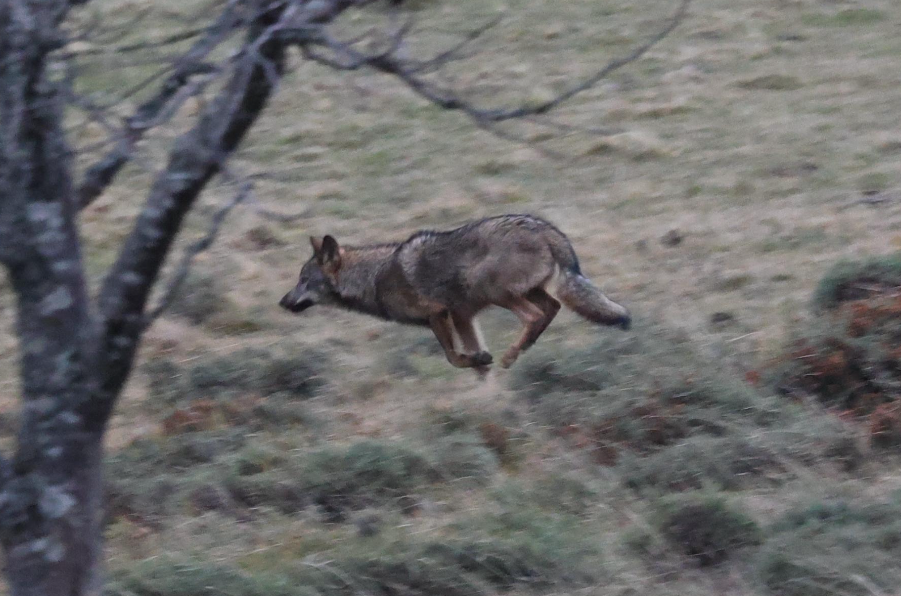
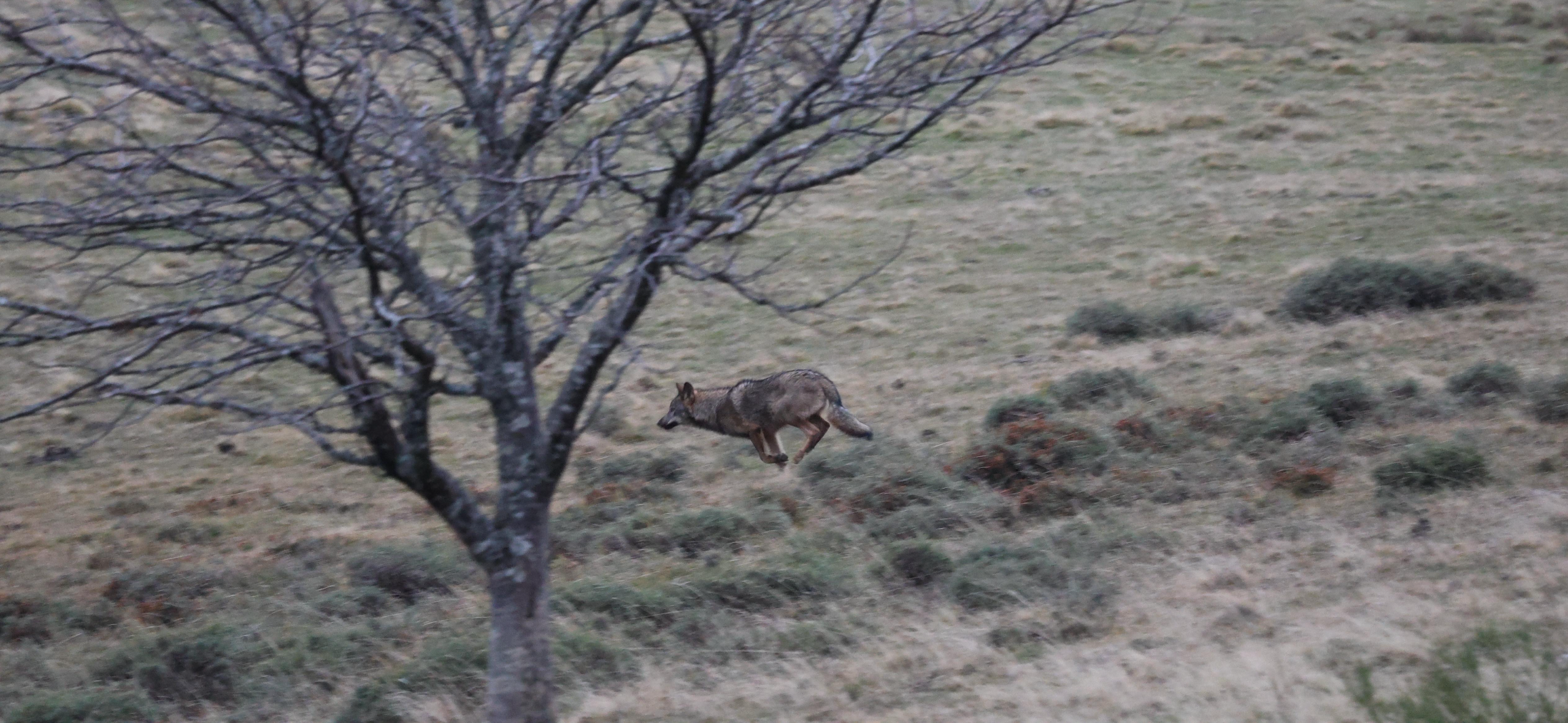
For background, the Iberian wolves we were tracking had been in these mountains unimaginably longer than any of the people now arguing over whether they should remain.
True grey wolves, Canis lupus, appear in the fossil record of northern Spain four hundred centuries ago. By the time Neanderthals were hunting the valleys and caves of the Cantabrian north, wolves were already old inhabitants. When our own subspecies of human arrived they found another social hunter pursuing much the same prey.
After the last Ice Age, the Iberian population became increasingly isolated from the other wolves of Europe, eventually becoming the distinctive animal traditionally classified as Canis lupus signatus — the ‘marked wolf’ — named for the dark streaks on its forelegs, tail and back.
A Spanish wolf pack like all other non-captive packs is a family. At its centre is a breeding pair, surrounded by their offspring from successive years.
(The whole Alpha-Beta-Male-Female complex is an artefact of early wolf biology being researched with captive packs, not wild ones, and its own early proponents like L. David Mech, with whom I spoke extensively on this matter, have since wheeled it back entirely – more on this later.)
Mating takes place towards the end of winter; after sixty-odd days the female produces, between April and June, five or six cubs, and only one female in a normal, intact pack breeds.
Those cubs make the size of a pack change dramatically with the seasons. In northern Spain travelling winter packs average about four animals, while successful breeding packs observed in summer averaged nearly seven and have been recorded as large as fourteen. The dozen wolves we watched moving down the mountain that night were therefore a large pack, but nothing out of the ordinary.
Their natural prey here is exactly what one would expect from the country: deer, boar and chamois, animals the wolves pursue through oak woods, scrub and open mountain in territories which can extend over hundreds of square kilometres. And that is where they found and contested the supremacy of man and, pre-gunpowder, it would have been a lot closer than it is today.
Recorded human mortality by wolves runs to the low tens of thousands, so biologically it would be improbable that a multiple of ten could be added to that number. And that is the survivors of a species systematically exterminated since the bow and arrow and pack of hounds came into use. (Again, I will dig deeper into these supposedly controversial – i.e. disputed among non-scientific pro-wolf advocates – numbers later in the book.)
However, among small hunter gatherer groups, where the actual numbers of hunters were often 2-6 men with spears, confronting packs of a dozen with a similar number of adult wolves adept at hunting, such conflicts would have had a far higher number of human fatalities.
And once pastoral agriculture became widespread, the oldest war acquired a new front. Palaeolithic man and wolf had competed as hunters for wild meat. Once men had livestock, keeping their prey alive and captive beside them, the game changed.
From the wolf’s point of view we had simply gathered deer that could not run properly, sheep that could barely defend themselves and calves enclosed behind fences. From ours, the wolf had ceased merely to be a rival hunter and became a thief.
The war against Lupus is written into the landscape. Documents from the sixteenth, seventeenth and eighteenth centuries record wolves throughout Cantabria, even down to the coast, together with the loberas built to trap them, communal hunts organised to drive them into those traps and rewards paid for their bodies.
Across the Cantabrian mountains entire villages could be summoned by church bell to take part in a wolf drive, men stationed along converging palisades forcing the animal towards a pit from which it would not emerge.
By 1788 Carlos III had made extermination official policy, ordering two great wolf drives every year and paying bounties for wolves, higher ones for females, and higher still for females taken with their litters.
Yet even in the middle of the nineteenth century wolves remained in every Spanish mainland province; the best reconstruction puts them across at least sixty-five per cent of the entire Iberian Peninsula, probably considerably more.
Modern Man merely became better at the job. Cantabria established its own Junta para la Extinción de Animales Dañinos, ‘harmful animals’, in 1943, an organisation whose success helped inspire General Franco’s post-Civil War government to impose similar extermination boards across Spain in 1953.
These did exactly what their name said. They organised the destruction of animals considered harmful to livestock and game, distributing poison, traps and snares and paying professional alimañeros, ‘pest controllers’, for the corpses they produced.
In Cantabria alone the authorities rewarded the killing of 555 wolves between 1943 and 1968. By the 1960s wolves had disappeared from the eastern edge of the region, become sporadic in the west and were reproducing only irregularly elsewhere. Across Spain they were driven back into a north-western refuge of Galicia, León, Zamora and the Cantabrian mountains, with a few doomed southern remnants. The extermination programme had very nearly worked.
The reversal began, ironically, while Franco was still alive. The Hunting Law of 1970 stopped treating the wolf simply as vermin to be destroyed and made it a species of big game, bringing its killing within seasons and rules; at much the same time Félix Rodríguez de la Fuente, the legendary Spanish naturalist and broadcaster, was doing something legislation alone could not have done, persuading millions of Spaniards that the wolf was part of Spain rather than an infestation upon it.
From its low point around 1970 the population began to recover, first within its north-western stronghold and then gradually outwards. By 1988 there were an estimated 1,500 to 2,000 wolves in Spain. The national census of 2012–14 found 297 packs; that of 2021–24 found 333.
Nowhere is that recovery more striking than here. Cantabria counted twelve family groups, perhaps 96 to 108 wolves, in 2012–14. By 2024 there were at least twenty-three packs and an estimated 184 to 207 animals ranging across 4,192 square kilometres — almost four-fifths of the region.
It is probably the largest wolf population Cantabria has possessed since anyone began counting them seriously, although nothing like the geographical abundance of earlier centuries.
And so the argument has turned again. Spain gave wolves nationwide special protection in 2021; in 2025 that protection was removed from the great northern population, and Cantabria’s new management plan permits controlled killing once more. The vocabulary has changed repeatedly — predator, thief, vermin, game animal, protected species, managed species — but the essential dispute has not. There are wolves in these mountains, there are men who raise and hunt the same animals they eat.
And they have guns.
 The Children Of Wolves